A desiccant pack works best when it can share air with the items inside a closed storage space. That means placement matters. A pack that is buried under heavy items, jammed into a hinge area, or used in a damp box may still adsorb moisture, but the setup can make the pack harder to inspect and less useful than it should be.
The safest way to think about placement is simple: keep the desiccant in the same enclosed air space, keep airflow around it, and keep it away from pressure points, seals, moving parts, and delicate surfaces.
This guide covers where not to place a desiccant pack in a storage box, why those spots cause trouble, and how to adjust the setup without making claims that one placement can guarantee a specific humidity result.
Quick Answer
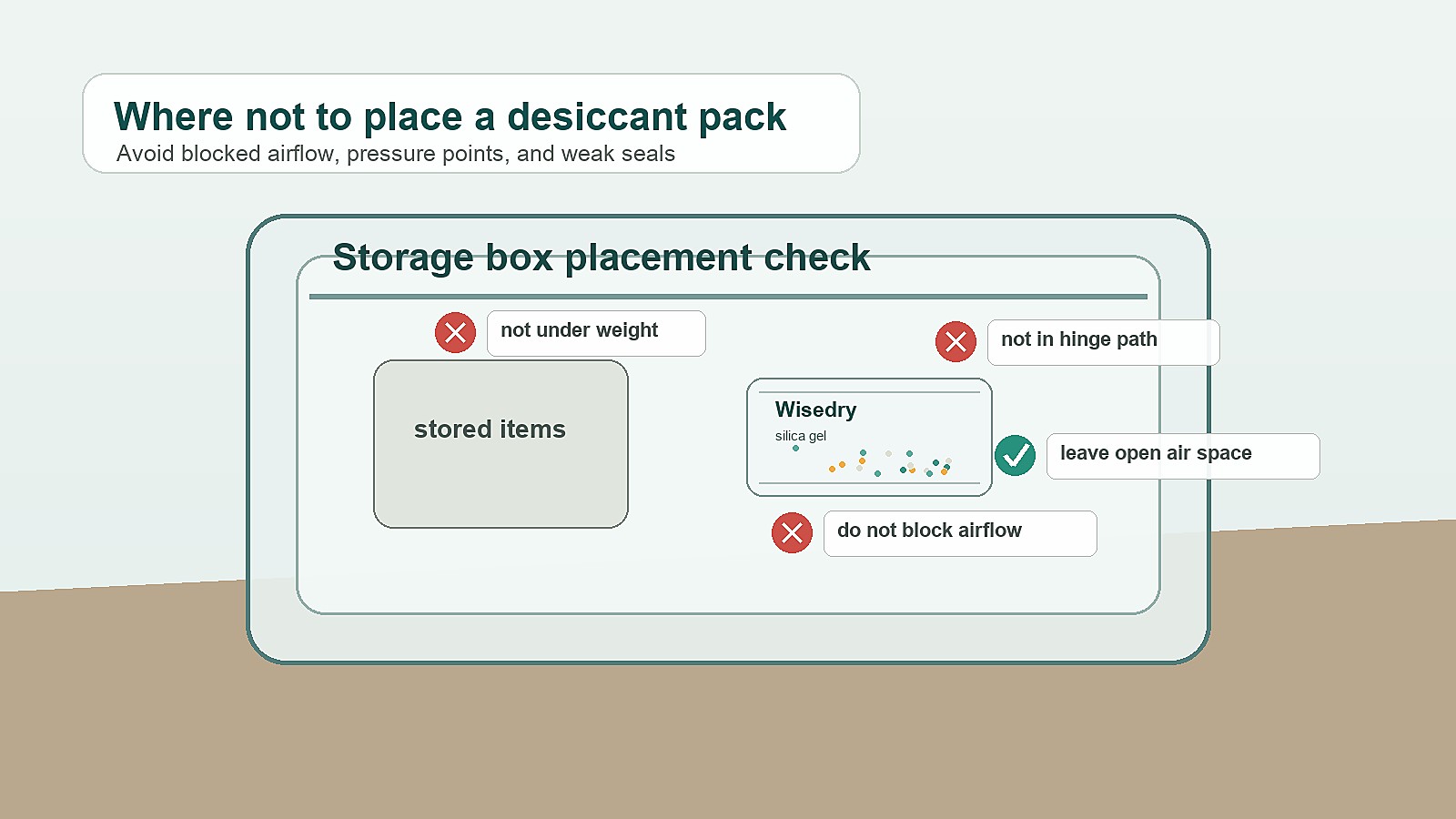
Do not place a desiccant pack under heavy stored items, pressed directly against paper or delicate surfaces, blocking a lid seal, jammed beside hinges or latches, loose in a wet box, or outside the sealed storage space. Put it in a visible corner, tray, side pocket, mesh pouch, or open area where air can circulate and the container can still close normally.
If you are unsure whether the container itself is the problem, first check the container seal without special tools. If the container is larger or opened often, use the full Wisedry silica gel amount guide to think through amount as well as placement.
Why Placement Matters
Silica gel and reusable desiccant packs do not need a perfect display setup. They do need reasonable access to the air inside the container. In a closed storage box, moisture can come from humid room air, a weak seal, frequently opened lids, slightly damp stored items, or packaging that was not fully dry before storage.
Placement affects four practical things:
- Airflow: the pack should not be buried so deeply that air cannot move around it.
- Inspection: you should be able to see or access the pack when checking, replacing, or recharging.
- Container closure: the pack should not stop a lid, zipper, gasket, latch, hinge, or lock from closing normally.
- Contact: the pack should not be pressed into paper edges, glass, screens, polished surfaces, soft materials, or moving parts.
Good placement cannot fix every storage problem. If the container leaks, the room is very humid, the box is opened all the time, or the stored items are damp, the desiccant may reach its used state sooner. But a clean placement setup makes the system easier to monitor and adjust.
Mistake 1: Burying The Pack Under Heavy Items
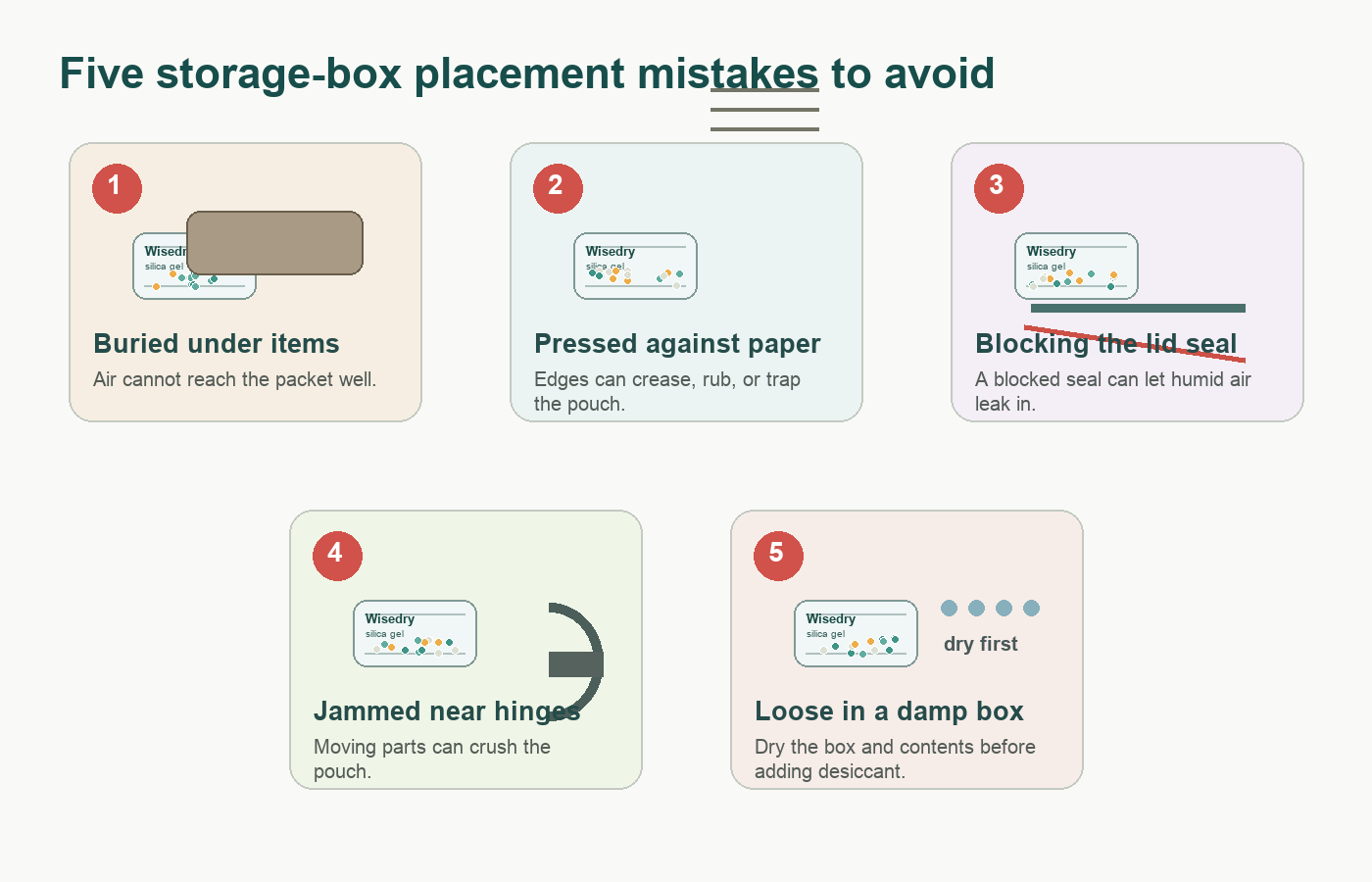
A common mistake is dropping the desiccant pack into the box first, then stacking books, tools, fabric, parts, keepsakes, or craft supplies on top of it.
This can cause several issues:
- Air has less room to move around the pack.
- The pouch can be flattened or creased.
- The pack becomes harder to find during checks.
- Indicator windows or labels may be hidden.
- Stored items may press against the pouch for a long time.
A better setup is to place the pack on a side shelf, shallow tray, corner, open pocket, or top layer where it stays visible and separated. It does not need to be in the exact center of the box. It just needs to be inside the same closed air space with some open room around it.
Mistake 2: Pressing It Directly Against Paper Or Delicate Surfaces
Desiccant packs are useful in document boxes, photo storage boxes, camera cases, craft bins, and small safes, but direct pressure is not ideal. Avoid wedging a packet tightly against paper edges, envelopes, photo surfaces, labels, screens, glass, leather, soft coatings, or polished items.
The issue is not that every brief touch is a disaster. The issue is long-term pressure, rubbing, and poor organization. A pouch that shifts during handling can crease paper, rub against finishes, or become trapped in a stack.
For paper, photos, or keepsakes, use one of these safer positions:
- A small tray beside the documents.
- A corner of the box with a divider.
- A breathable pouch that keeps the packet from rubbing.
- A top area that is easy to see when the lid opens.
If the storage box is very tight, use a slightly larger container instead of forcing the desiccant pack into the only open gap.
Mistake 3: Blocking The Lid, Zipper, Gasket, Or Seal
A desiccant pack should not sit where the container closes. If it blocks a lid, zipper, gasket, latch, or snap closure, it may create a small gap. That gap can let humid room air enter, which increases the moisture load on the desiccant.
This is easy to miss with soft bags and flexible plastic boxes. The lid may look closed from the outside, but one corner may be lifted by the packet.
Before putting the box away:
- Close the lid without forcing it.
- Check all corners and edges.
- Make sure the packet is not trapped in the closure path.
- Open the box once and confirm the pack is still where you intended.
If the lid only closes when you push hard, the placement is wrong or the container is too full.
Mistake 4: Jamming The Pack Near Hinges, Locks, Or Moving Parts
Hinges, locks, zippers, handles, dividers, and sliding trays are bad places for a desiccant pack. Moving parts can crush the pouch, drag it out of position, or make the container harder to close.
This matters in:
- Small safes and lock boxes.
- Camera cases and lens cases.
- Tool cases and parts organizers.
- Craft boxes with folding trays.
- Storage tubs with snap lids.
Use a fixed corner, small tray, side pocket, or shallow container area instead. The pack should be easy to remove without pulling against a hinge or latch.
For more positive placement examples across camera bags, lens cases, safes, and storage boxes, see the Wisedry guide on where to put silica gel in camera bags, safes, and storage boxes.
Mistake 5: Putting Desiccant Into A Damp Or Dirty Box
Desiccant is not a substitute for drying the container first. If the storage box has condensation, a damp smell, wet packaging, water spots, or damp items inside, fix that first.
A better sequence is:
- Empty the box.
- Wipe or air-dry the container fully.
- Remove damp packaging, wet fabric, or questionable inserts.
- Check whether the lid or seal is allowing moisture in.
- Add active desiccant only after the container and contents are dry enough for storage.
If a pack reaches its used state quickly after you fix placement, the issue may be a weak seal, high room humidity, frequent opening, or damp contents rather than the packet location alone.
Need product-specific help with a Wisedry packet or container setup? Ask Wisedry support.
Mistake 6: Placing The Pack Outside The Sealed Space
A desiccant pack needs to be inside the enclosed air space it is helping manage. Putting a packet on the outside of a box, on a nearby shelf, or in a separate pouch outside the container will not treat the air inside the sealed box in a meaningful way.
Common examples:
- A packet taped to the outside of a plastic bin.
- A packet placed in a cabinet while the items are sealed inside a separate box.
- A packet left in an outer tote while the important item is inside an inner bag.
- A packet stored in the same room but not inside the actual container.
Use the same-air-space rule: if the stored item is inside a box, the desiccant should also be inside that box. If the item is inside a sealed inner bag, the desiccant usually needs to be inside that sealed inner bag as well, unless the product instructions say otherwise.
Mistake 7: Using One Pack In A Full Box With No Air Gap
A very full box can limit airflow and make inspection difficult. Even if the amount of desiccant is reasonable, a pack buried in a packed container may not be easy to check or reposition.
This often happens with seasonal storage, craft supplies, fabric bins, tool cases, and document boxes. The solution is not always to add more desiccant first. Start by improving the layout:
- Leave a small open area around the pack.
- Spread multiple packs apart in a larger box.
- Keep packets visible instead of hidden under the bottom layer.
- Use dividers, trays, or side pockets to prevent shifting.
- Avoid overfilling the container so the lid closes cleanly.
If the box is large, loosely sealed, or opened frequently, check the full Wisedry silica gel amount guide after fixing placement.
Better Placement Rules
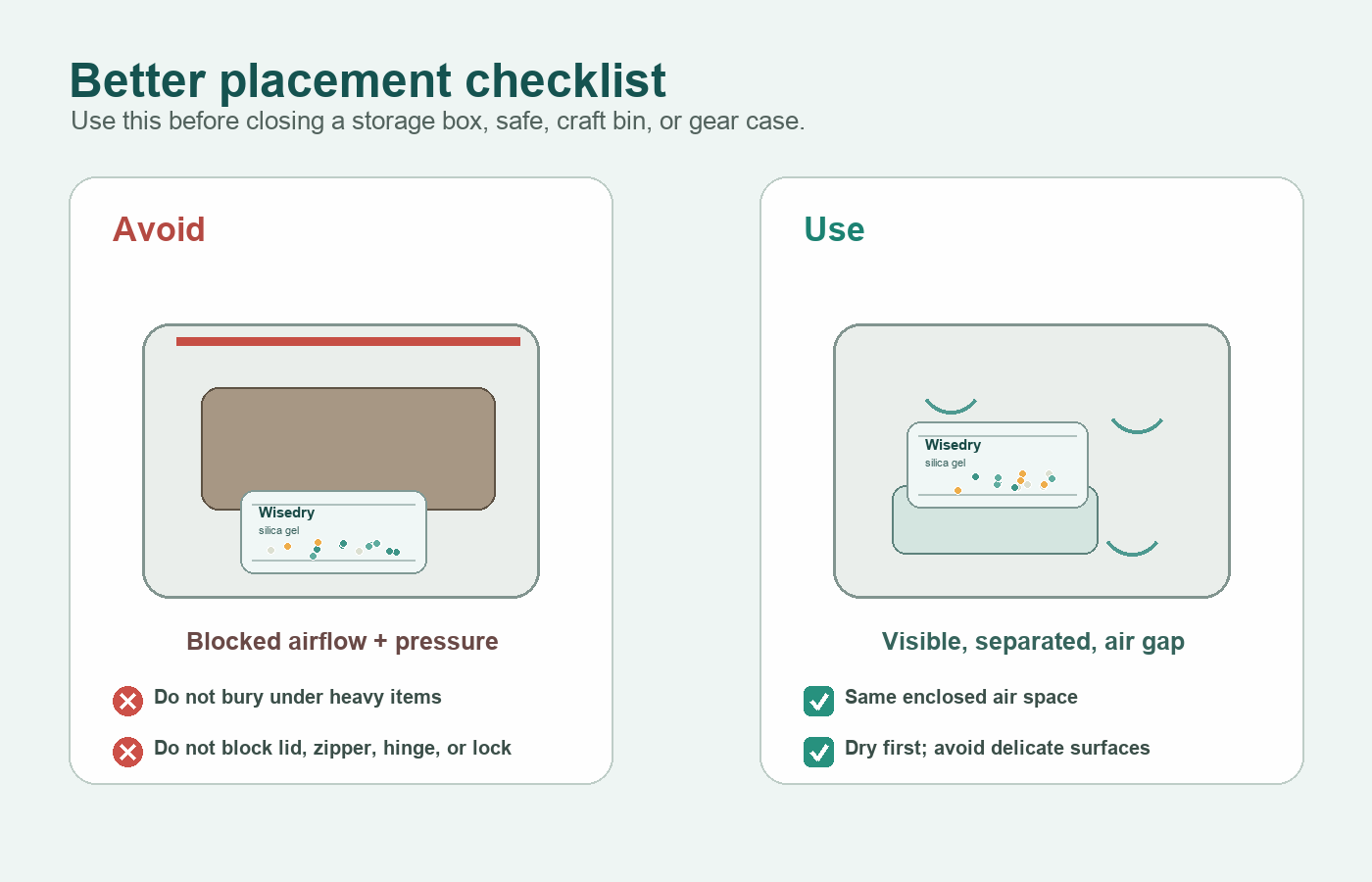
Use these rules before closing the container:
- Same enclosed space: the desiccant and stored items share the same closed air space.
- Visible and reachable: you can find the pack without digging through everything.
- Air gap: the pack is not tightly buried or sealed behind layers.
- No closure blockage: lid, zipper, hinge, latch, gasket, and lock still close normally.
- No direct pressure: the pack is not wedged against delicate surfaces.
- Dry first: the container and items are dry before the desiccant goes in.
- Easy to check: the pack can be removed for inspection, recharge, or replacement.
For small safes, document boxes, and compact storage boxes, this pairs well with the Wisedry guide on how much silica gel to use in a small safe, document box, or storage box.
What To Do If The Pack Keeps Saturating Quickly
If placement looks good but the pack still reaches its used state quickly, check the system around it.
Look for:
- A loose lid or imperfect seal.
- A container opened many times.
- Damp items added to the box.
- A humid storage room.
- Too little desiccant for the container size.
- A pack that was already partly used before storage.
The Wisedry troubleshooting guide on signs a desiccant pack is no longer performing as expected can help you decide what to check next without assuming the packet has failed.
Simple Setup Workflow
Use this short sequence whenever you set up a storage box:
- Start with a clean, dry container.
- Check that the lid, seal, zipper, or latch closes normally.
- Place stored items without overfilling the box.
- Put the desiccant in a visible corner, tray, side pocket, or open area.
- Close the box and confirm the pack is not in the closure path.
- Reopen once to make sure the pack did not shift.
- Label the box if you plan to check or recharge packets later.
This keeps the setup practical. You do not need a complicated layout for a basic storage box. You need a pack that fits, stays accessible, and does not interfere with the container.
FAQ
Should A Desiccant Pack Go On Top Or Bottom Of A Storage Box?
Either can work if air can circulate and the pack stays inside the same enclosed air space. In many home storage boxes, a visible side corner or shallow tray is easier to inspect than the very bottom of the box.
Can A Desiccant Pack Touch Stored Items?
Light contact may happen in normal storage, but avoid long-term pressure against paper edges, glass, screens, soft finishes, polished items, hinges, locks, zippers, or moving parts. Use a tray, divider, or breathable pouch when separation matters.
Is It Better To Use One Large Pack Or Several Small Packs?
It depends on the container size, layout, seal quality, humidity, and opening habits. Several smaller packs can be easier to spread around a larger box. One larger pack may be simpler in a compact container if it fits without blocking the lid or pressing on items.
Does Placement Matter If The Box Is Airtight?
Yes. A better seal helps, but the pack still needs to be inside the same enclosed air space, reachable for checks, and away from pressure points or closure paths.
Can Silica Gel Fix A Damp Storage Box?
Do not use silica gel as the first fix for a damp box. Dry the container and contents first, then add active desiccant as part of the storage setup.
What If I Cannot Find A Good Spot For The Pack?
Use a larger container, remove clutter, add a small tray or divider, or choose a pack size that fits the available space. Do not force a packet into a hinge, zipper, lock, or tight paper stack.
Related Wisedry Resources
- Where to put silica gel in camera bags, safes, and storage boxes
- Check the container seal without special tools
- How much silica gel to use in a small safe, document box, or storage box
- Full Wisedry silica gel amount guide
- Shop Wisedry reusable desiccants
- Ask Wisedry support
Closing
Desiccant placement is not about finding one perfect spot. It is about avoiding a few practical problems: blocked airflow, pressure, weak closure, hidden packets, and damp containers.
Place the pack where it can share air with the stored items, stay visible, and avoid the lid, hinge, lock, zipper, and delicate surfaces. If the setup still seems demanding, check the seal, amount, opening habits, and room humidity before assuming the desiccant pack is the only issue.
Craft organizers follow the same rules; the silica gel for craft supply storage guide shows where packets and checkups fit a hobby box routine.