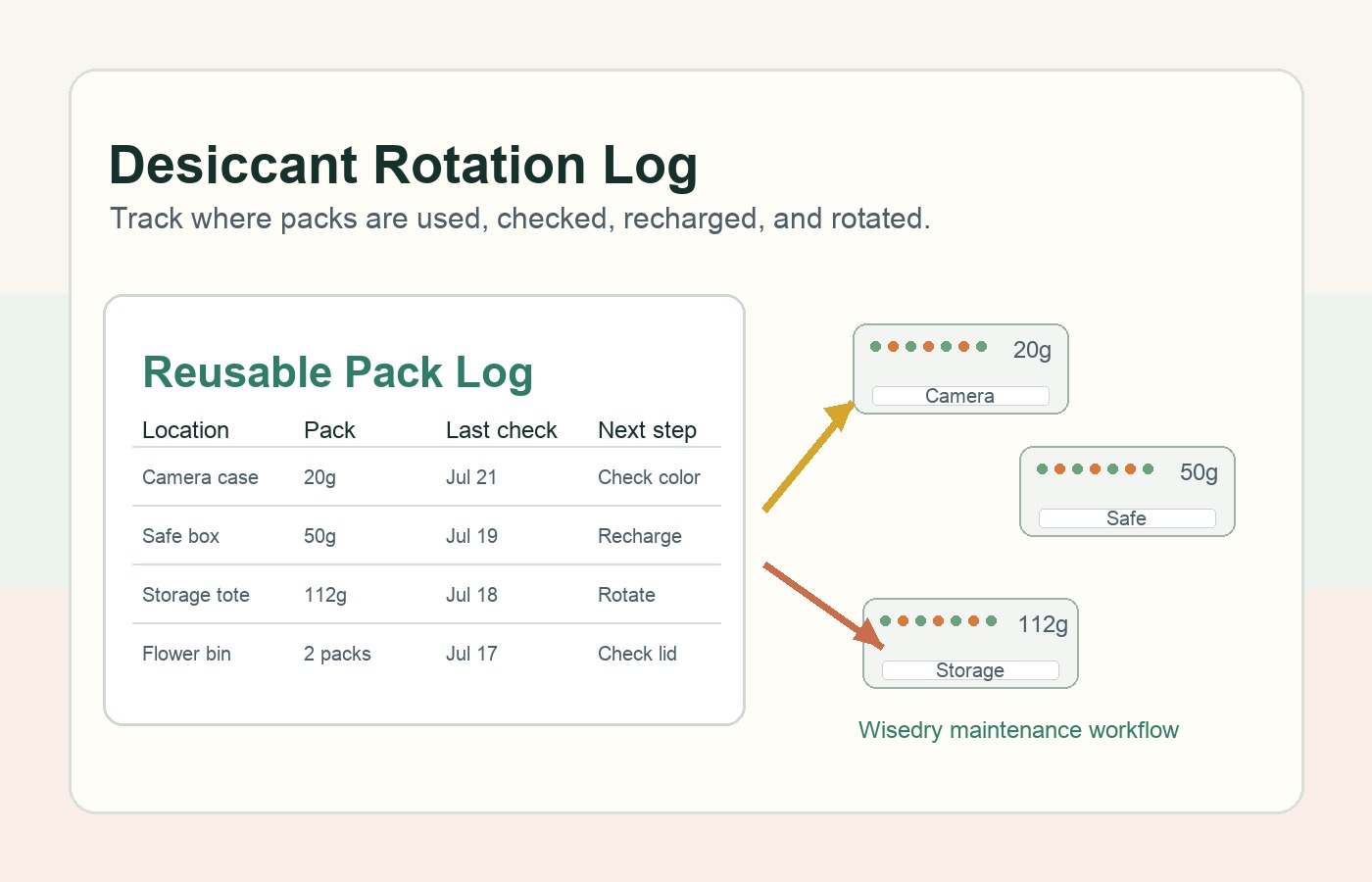
If you use reusable desiccant packs in more than one place, a simple rotation log helps you avoid two common problems: forgetting which pack needs attention, and putting a warm or recently recharged pack back into storage too soon.
Quick answer: create one short log row for each container or project. Track the location, pack size, date placed, last check, current observation, and next action. Use the log as a reminder system, not as a fixed performance promise.
Why A Rotation Log Helps
Reusable silica gel packets are easy to move between camera bags, safes, document boxes, storage totes, flower drying projects, and seasonal containers. That flexibility is useful, but it also creates small maintenance gaps.
A rotation log helps you answer:
- Where is each desiccant pack right now?
- When was it last checked?
- Was it dry, changing color, heavy, warm, or ready to reuse?
- Which pack should be recharged next?
- Which container may need a better seal or a different pack size?
The goal is not to predict an exact lifespan. Moisture exposure, container tightness, opening frequency, pack size, and the items inside the container all affect how quickly a desiccant pack becomes ready for recharge.
What To Track In The Log
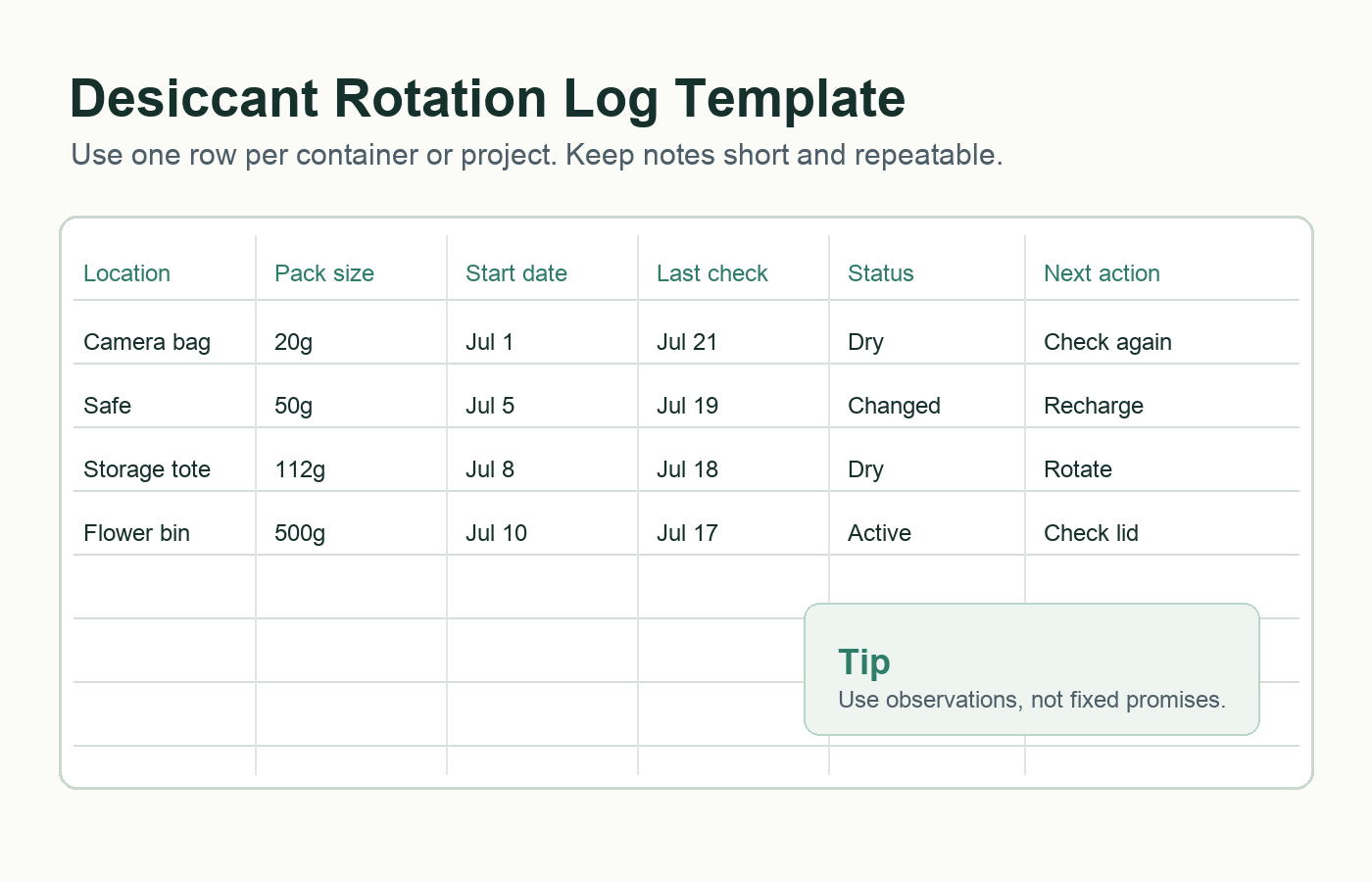
Keep the log short enough that you will actually use it. These fields are usually enough:
- Location: camera case, safe, document box, storage tote, closet bin, flower drying container, or another clear name.
- Pack size or type: for example, 20g, 50g, 112g, 500g bag, beads, or flower drying crystals.
- Date placed: the date the pack went into that container.
- Last check: the latest date you looked at the pack or container.
- Observation: dry, color changed, heavier than usual, container opened often, still warm after recharge, or needs review.
- Next action: keep using, check again, recharge, cool before reuse, move to another container, or contact support.
Example row:
- Camera bag – 20g pack – placed Jul 1 – checked Jul 21 – indicator still dry – check again next time the bag is reorganized.
That is enough. A log does not need exact humidity readings unless you already use a hygrometer and want that extra detail.
A Simple Four-Zone Rotation System
If you manage several packs, use four physical zones on a shelf, tray, or drawer:
- Ready to use: packs that have been checked, cooled after recharge if needed, and are ready to return to a container.
- In use: packs currently inside storage containers or active projects.
- Needs recharge: packs moved out after color change, weight change, repeated moisture exposure, or other signs they need attention.
- Cooling or review: packs that have just been recharged, still feel warm, or need one more check before going back into storage.
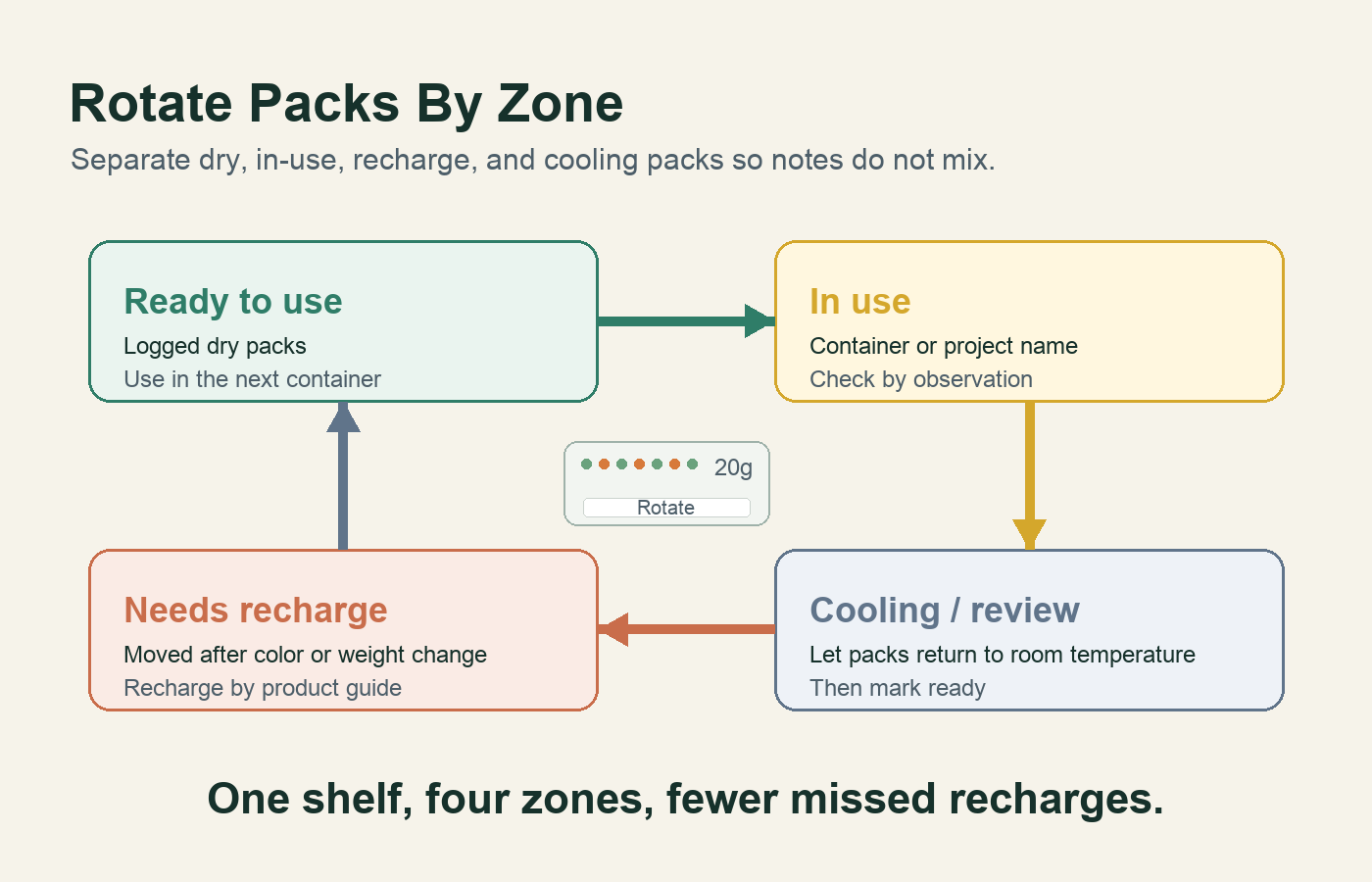
This four-zone method keeps recently recharged packs away from dry, ready-to-use packs. It also helps prevent old notes from following the wrong packet into the wrong container.
When To Move A Pack To “Needs Recharge”
Do not move a pack only because a calendar says so. Move it when the observation supports the action.
Common reasons include:
- Indicator beads have changed toward their saturated color.
- The pack feels heavier than it did when dry.
- The container was opened often or exposed to damp air.
- The stored item went in damp and needs closer checking.
- The container still shows moisture signs after the pack has been in use.
For visual checks, use Wisedry’s guide on how to tell if a silica gel packet is saturated. For product-specific recharging, start with the Wisedry recharge hub or the 20g, 50g, and 112g packet recharge guide.
What To Write After Recharging
After recharging, write the new status in the log before the pack disappears back into a drawer or container.
Useful notes include:
- Recharged today.
- Cooling before reuse.
- Returned to camera bag.
- Moved from safe to storage tote.
- Needs next check after the container is opened again.
If you also label the container or packet, keep the label short. The log can hold the detail, while the label can show the last recharge date, pack size, and location. For a compact label format, use Wisedry’s guide to writing a recharge date on a desiccant storage label.
Do Not Put Warm Packs Straight Back Into Closed Storage
A rotation log is also useful immediately after recharge. A pack may be technically recharged but still warm. Before putting it back into a closed container, let it return to room temperature and check that it is ready for normal handling.
If this is a recurring question in your workflow, read how to cool silica gel after recharging before reuse. The log should make this step visible by giving warm packs their own “cooling / review” status.
How Often Should You Check The Log?
Use a practical trigger instead of a universal schedule:
- Check when you open or reorganize the container.
- Check after a damp item has been added.
- Check before long-term storage.
- Check before moving packs between containers.
- Check when indicator color, weight, or container conditions suggest a change.
For small safes, document boxes, camera cases, or storage totes, the right amount of silica gel also matters. If a container seems to need recharging very often, review the Wisedry silica gel amount guide and check whether the container seal is part of the issue.
A Copyable Starter Log
Use this simple structure in a notebook, spreadsheet, label sheet, or notes app:
- Location:
- Pack size:
- Date placed:
- Last check:
- Observation:
- Next action:
- Notes:
For most homes, that is better than a complicated tracker. The important habit is to record the observation at the moment you check the pack, then move the pack to the correct next zone.
Recommended Next Step
If you are building a reusable moisture-control kit, start with the containers that matter most: the camera bag, safe, document box, seasonal storage tote, or flower drying bin you open most often. Add one log row for each location, then update it when you check the pack.
Need more packs for a rotation setup? Visit the Wisedry shop for reusable silica gel desiccants. If you are unsure which recharge guide applies to your Wisedry product, use the Wisedry support center.
FAQ
Is A Desiccant Rotation Log The Same As A Recharge Schedule?
No. A schedule is based mainly on dates. A rotation log records where the pack is, what you observed, and what action comes next. The log can include dates, but it should not replace visual checks or product-specific recharge instructions.
Should I Write A Fixed Recharge Date For Every Pack?
Use dates as reminders, not guarantees. Some containers expose packs to more moisture than others. If a pack shows signs of saturation before the next reminder date, follow the observation and recharge or replace it as appropriate.
Can I Use One Log For Different Pack Sizes?
Yes. Just record the pack size or type in each row. This matters because a 20g packet, 50g packet, 112g packet, 500g bag, beads, and flower drying crystals may be used and recharged differently.
What If A Pack Keeps Needing Recharge Quickly?
Check the container first. It may be opened often, poorly sealed, too large for the pack size, or holding items that went in damp. Review the amount guide and the saturation checklist before assuming the pack itself is the problem.
Where Should I Keep The Log?
Keep it where you maintain the packs: on a storage shelf, inside a drawer, in a spreadsheet, or in a phone note. The best log is the one you can update immediately when you move a pack from “in use” to “needs recharge” or “ready to use.”
If your rotation includes packs that sit idle between seasons, the guide to keeping rechargeable desiccant ready for seasonal storage covers the recharge, cool-down, label, and seal routine before a pack goes into long storage.
To turn the log into a complete working routine, use the ready, in-use, and recharge rotation system for swapping reusable packets between labeled storage containers.